


How to Choose the Right Private Label Sunglasses Styles for Your Target Market
Choosing the right private label sunglasses styles requires more than selecting attractive frames: brand owners must align design, fit, lens function, compliance, price and production quantities with the needs of a specific customer segment. Start by defining the target buyer and sales channel, then shortlist frame materials and silhouettes, verify lens claims and relevant market requirements, test samples on a representative range of wearers, and confirm supplier capabilities before placing a bulk order. A focused assortment of everyday, fashion and performance options can help retailers and distributors serve distinct use cases without creating unnecessary inventory complexity.
Match Sunglass Designs to the Customers and Channels You Serve
Build a customer profile before choosing silhouettes
Translate broad labels such as “fashion customer” or “outdoor enthusiast” into practical product requirements. Consider age range, face-fit preferences, typical activities, climate, purchase budget and how customers discover the product. A commuter buying sunglasses as an everyday accessory may prioritize comfort, versatile colors and an easy-to-style shape. A beachwear shopper may respond to expressive colors and seasonal details, while a cyclist or runner may seek secure retention, coverage and reduced visual distractions. These are useful starting hypotheses, not universal rules; validate them against sales data, customer interviews, search behavior and competitor assortments in the intended market.
Channel strategy changes the selection criteria. A marketplace listing competes through product photography, clear specifications and price comparison. A boutique can support distinctive finishes and a more curated story, while an optical retailer may expect precise lens and fit information. Distributors also need dependable replenishment, stable color matching and packaging that works across multiple accounts. Before requesting designs from manufacturers, record the target retail price, expected landed cost, desired margin, planned launch date and channel-specific packaging requirements. These constraints help prevent attractive concepts from progressing into commercially unworkable samples.
Use a deliberate assortment rather than a collection of unrelated trends
A practical first range can include a recognizable core silhouette, a differentiated fashion option and a use-specific design where customer demand supports it. The core style should be easy to merchandise and available in commercially sensible colorways. A statement frame can help the collection stand out, but its buying quantity should reflect the greater risk of trend changes. Performance-oriented options should be included only when the target audience and product specification justify their additional design and testing requirements. Buyers should review the assortment as a whole: repeated shapes, overlapping colors and unclear differences make it harder for customers to choose and can leave retailers with slow-moving stock.
Ask for evidence behind trend recommendations. Supplier lookbooks can reveal available shapes and finishes, but regional demand should be checked using retailer sell-through, marketplace listings, local competitors and customer feedback. Compare a proposed style with products actually available at the intended price point, not just editorial images. A supplier’s ability to produce a design does not establish that the design will fit the brand, channel or market.
Compare Frame Materials, Fit and Lens Features by Use Case
Select materials for the expected wearing conditions
Frame material affects weight, flexibility, appearance, finish options and cost. Acetate can support rich colors and a polished fashion presentation; metal frames can create a slim, refined look but require close attention to nose-pad comfort, finish durability and adjustment. TR Sunglasses use a lightweight thermoplastic frame approach that may suit buyers seeking flexible everyday styles. PC sunglasses can be considered for lightweight designs, including certain sport-oriented concepts, but the complete product still needs suitable design validation and clear performance specifications. Material names alone do not prove durability or comfort: request samples, inspect hinges and contact points, and test the frame under conditions relevant to the intended customer.
Fit is an operational and commercial issue as well as a design choice. A frame that looks appealing in a flat product image may sit too low, pinch at the temples or slide during movement. Review lens width, bridge dimensions, temple length, curvature and overall coverage, and ask for measurements in a consistent format. Test samples on wearers with varied face shapes where possible. For sport and active-use designs, assess stability during movement and compatibility with the intended activity; do not describe a general fashion frame as protective sports equipment without substantiation. Confirm whether adjustable components, replacement parts or fit guidance are needed for the sales channel.
Specify lens function and claims with care
Lens selection should begin with the intended use and the claims the brand plans to make. Buyers commonly compare tint, visible light transmission, color perception, polarization, UV protection and optical quality. These characteristics are not interchangeable: a dark tint does not, by itself, establish UV protection, and polarization should not be presented as a substitute for UV filtration. Request the lens specification, test documentation and labeling details for the exact finished product. The ISO 12312-1 standard addresses requirements and test methods for sunglasses for general use; buyers should confirm the applicable edition and market requirements with a qualified compliance professional.
Requirements can differ by destination and product category. In the United States, 21 CFR 801.410 includes impact-resistance requirements for certain spectacle lenses. This is a reason to confirm regulatory scope for the product and sales channel rather than assume that a supplier’s general statement covers every model. The World Health Organization’s information on ultraviolet radiation explains the relevance of UV exposure to health. For prescription products, confirm that lens powers, optical measurements, fitting information and quality checks are appropriate to the intended market; customized sunglasses and custom prescription lenses may involve distinct operational and regulatory considerations.
| Product direction | Typical buyer priority | Questions to resolve before ordering |
|---|---|---|
| Everyday acetate or TR frame | Comfort, versatile styling and a choice of colors | How do dimensions, hinge construction, finish and sample fit compare with the target price? |
| Metal fashion frame | Slim appearance, finish quality and refined detailing | Are nose pads comfortable, coatings consistent and contact points suitable for extended wear? |
| PC or sport-oriented frame | Low weight, coverage and stability for the stated activity | Has the complete design been evaluated for its intended use, fit and claims? |
| Polarized or prescription option | Specific visual function and accurate product information | Are lens specifications, test records, labeling and market requirements documented for the finished item? |
The table is a product-planning aid, not a substitute for testing or legal review. Performance depends on the finished design, component quality and intended use, so buyers should evaluate production-representative samples rather than rely on material names or concept drawings.
Evaluate a Supplier’s Ability to Deliver a Repeatable Collection
Check product development, sampling and change control
When assessing private label sunglasses suppliers, examine how the supplier turns a brief into a repeatable product. Ask who owns design files and tooling, which components can be customized, how many sample revisions are typical, and how approvals are recorded. Confirm whether logo placement, color matching, lens options, packaging and accessories are included in the quoted scope or priced separately. A detailed specification sheet should identify frame dimensions, materials, lens features, color references, branding positions, packaging and agreed inspection criteria. Without a controlled specification, two production runs may differ even when the product name stays the same.
Sample approval should cover more than appearance. Compare each sample with the approved drawing and specification, inspect assembly and finish, assess fit, and check any functional claims through appropriate testing. Record approved samples or retain a signed reference sample where feasible. Clarify how substitutions are handled if a component becomes unavailable, and require written approval before changes to materials, coatings, dimensions or packaging. These controls are particularly important when a buyer plans a seasonal launch, repeat orders or distribution across several regions.
Compare commercial terms and quality controls as a complete offer
Unit price is only one part of landed cost. Include tooling, sample fees, packaging, labeling, freight, duties, inspection, payment terms and potential rework in the comparison. Verify minimum order quantities by style, color and lens configuration; a low minimum for one component may not apply to every variation. Ask for realistic production and shipping lead times, capacity information and a clear escalation process for defects or delays. Buyers should also establish acceptance criteria before production, including the inspection method, defect classifications, sampling plan and corrective-action expectations.
Documentation should match the product, destination and claims. Request relevant test reports and confirm that they identify the specific model or materials being purchased. Ask how production lots are traced and how complaints or quality issues are investigated. Avoid treating a certificate, test report or factory statement as blanket proof for every style in a collection. A credible sourcing decision depends on the fit between documented evidence, the finished item and applicable requirements, as well as on transparent communication when a design or specification changes.
Turn the Selected Styles into a Scalable Private Label Program
Plan customization around clear product roles
Customization is most effective when each change strengthens the product’s role in the assortment. A logo on the temple, a distinctive color, custom packaging or a lens tint can support brand recognition, but extra variants increase forecasting and inventory demands. Begin with a small number of purposeful options, then expand when customer response supports the investment. For buyers developing custom glasses, define which elements are essential to the brand and which can remain standard. This distinction helps contain tooling costs, shorten development discussions and keep future replenishment manageable.
Different product families require different briefs. A fashion-focused customized sunglasses range may need coordinated frame and lens colors, while custom sport sunglasses should be specified around fit, coverage, retention and the actual activity. Buyers considering custom glasses lenses or custom prescription lenses should define optical requirements and handling processes with qualified specialists. For sports concepts, customize sport sunglasses only after confirming the intended performance features, test plan and claims. Clear product roles make it easier for sales teams to explain why one style differs from another and help buyers compare supplier proposals on equivalent terms.
How our product range can support buyer requirements
Our range covers custom glasses, customized sunglasses, PC sunglasses, TR Sunglasses and metal sunglasses, alongside custom glasses lenses and custom prescription lenses. For buyers developing active-use assortments, our custom sunglasses sports and custom sport sunglasses options can be considered against a defined activity, fit brief and performance specification. This breadth allows project owners to evaluate different style directions within a related product program, from everyday eyewear to sport-oriented designs, while keeping the decision grounded in the target customer and intended sales channel.
Our approach is to work from the buyer’s product brief: target customer, market, channel, design references, required customization and documentation needs. Buyers can use that brief to compare materials, shapes, lens configurations and branding options, then review samples against agreed criteria before confirming an order. Since no single frame or lens configuration suits every market, buyers should request product-specific information and verify the requirements that apply to their destination and claims. A disciplined development process supports clearer purchasing decisions, more consistent specifications and a collection that is easier to merchandise and replenish.
To discuss a product brief or explore our customized eyewear range, contact our team or view our products.
Frequently Asked Questions
How should a brand choose sunglasses styles for a target market?
Define the target customer, use case, sales channel, budget and expected retail price. Validate style hypotheses using local sales data, competitor assortments, customer feedback and representative sample testing before committing to production.
Which frame materials are suitable for private label sunglasses?
Acetate can support rich colors and a polished fashion look, metal can create a slim appearance, and TR or PC options may suit lightweight designs. Material names alone do not establish comfort or durability, so inspect samples, fit, hinges, finishes and contact points.
What should buyers check when evaluating sunglass lenses?
Review the intended use, tint, visible light transmission, polarization, UV protection, optical quality, labeling and test documentation for the exact finished product. A dark tint does not by itself establish UV protection, and requirements vary by market and product category.
How can buyers assess a sunglasses supplier before placing an order?
Review the supplier’s sampling and change-control process, customization scope, minimum order quantities, lead times, quality controls, documentation and commercial terms. Confirm that test reports and specifications apply to the actual product being purchased.
What should be included in a private label sunglasses specification?
Document frame dimensions, materials, lens features, colors, branding positions, packaging, inspection criteria and applicable claims. Record sample approvals and require written approval for substitutions or changes to materials, coatings, dimensions or packaging.
What should buyers consider when developing sport or prescription sunglasses?
Define the activity, fit, coverage and performance claims for sport designs, then determine an appropriate product-specific evaluation plan. For prescription products, confirm optical requirements, measurements, quality checks and applicable market requirements with qualified specialists.
- Match Sunglass Designs to the Customers and Channels You Serve
- Build a customer profile before choosing silhouettes
- Use a deliberate assortment rather than a collection of unrelated trends
- Compare Frame Materials, Fit and Lens Features by Use Case
- Select materials for the expected wearing conditions
- Specify lens function and claims with care
- Evaluate a Supplier’s Ability to Deliver a Repeatable Collection
- Check product development, sampling and change control
- Compare commercial terms and quality controls as a complete offer
- Turn the Selected Styles into a Scalable Private Label Program
- Plan customization around clear product roles
- How our product range can support buyer requirements
- Frequently Asked Questions
How Are Coated Lenses Manufactured? A Step-by-Step Production Overview
Surface treatments and plating technologies implemented in an eyewear factory
Custom Logo and Packaging for Vintage Round Polarized Sunglasses
Customization options offered by an eyewear factory: colors, logos, engraving and packaging
You May Also Like

Classic Square Polarized Sunglasses | High-Performance OEM Eyewear
As a premier oem sunglasses manufacturer, Karuson presents this essential Square Frame series—a staple for any eyewear brand’s core collection. These sunglasses feature a timeless matte black finish and are equipped with vibrant green REVO mirrored lenses, offering a perfect blend of modern tech aesthetics and professional-grade eye protection.
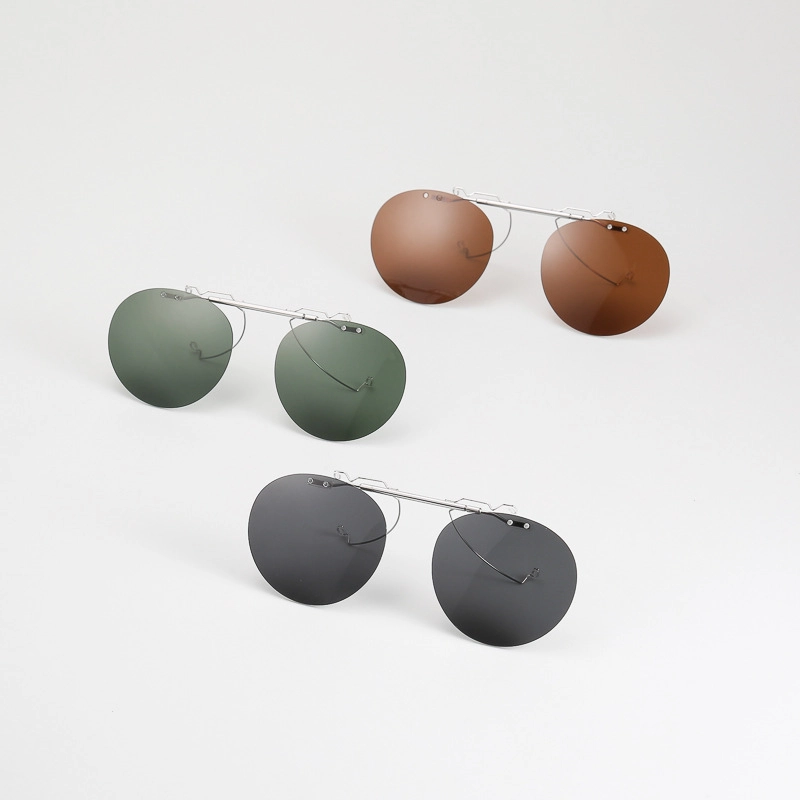
Round Polarized Flip-Up Clip-On Sunglasses for Prescription Glasses
Turn everyday prescription glasses into a retro-inspired sunwear look with these round flip-up clip-on sunglasses. The clean, rimless circular lenses sit in front of an existing optical frame, while the slim metal attachment can be lifted upward when the wearer wants to move between tinted and untinted vision without removing the clip-on.
Small silicone-padded contact points and an understated metal structure keep the focus on the frame already being worn. The range is presented in grey, brown, green and yellow tint options, making it a versatile add-on for optical boutiques and eyewear accessories collections. Actual lens performance and compatibility vary by configuration and should be confirmed with samples.
For wholesale and private label sourcing, discuss available tint combinations, lens specifications, logo or packaging options, and clip fit with KARUSON before confirming your assortment.
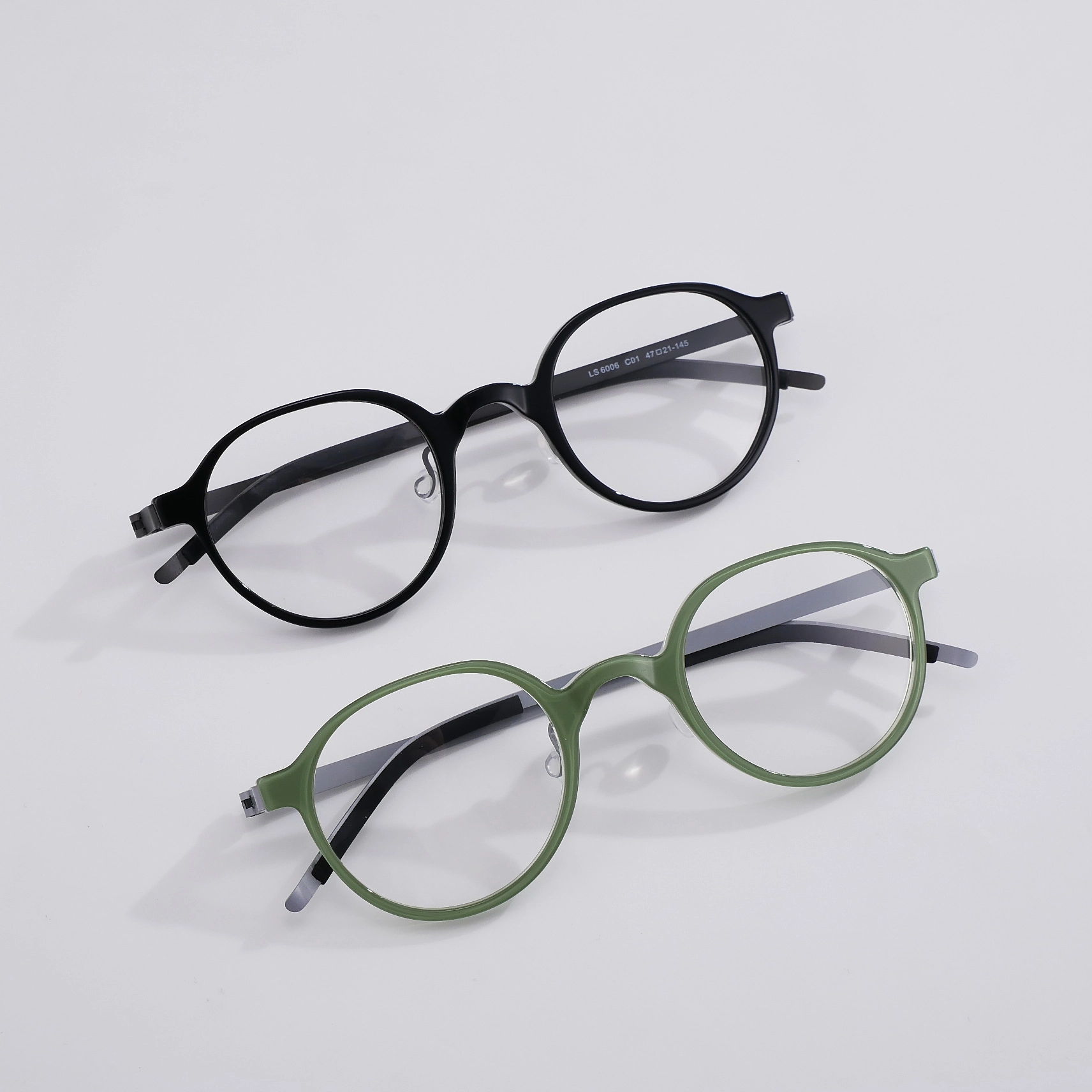
Screwless Round Acetate Optical Frames with Slim Alloy Temples
Understated from the front, refined from every angle. These round acetate optical frames combine a softly rounded silhouette with slim alloy temples for an effortless, modern-retro look. The polished front lends definition to the shape, while delicate metal sides keep the profile visually light.
Adjustable silicone nose pads offer room for fit adjustments, and the listed frame weight is just 11 g without lenses. A versatile choice for optical boutiques, everyday prescription eyewear ranges and brands building minimalist unisex collections.
Available color finishes and prescription lens compatibility can be discussed for each order, along with custom logos and branded packaging for wholesale or private label programs.
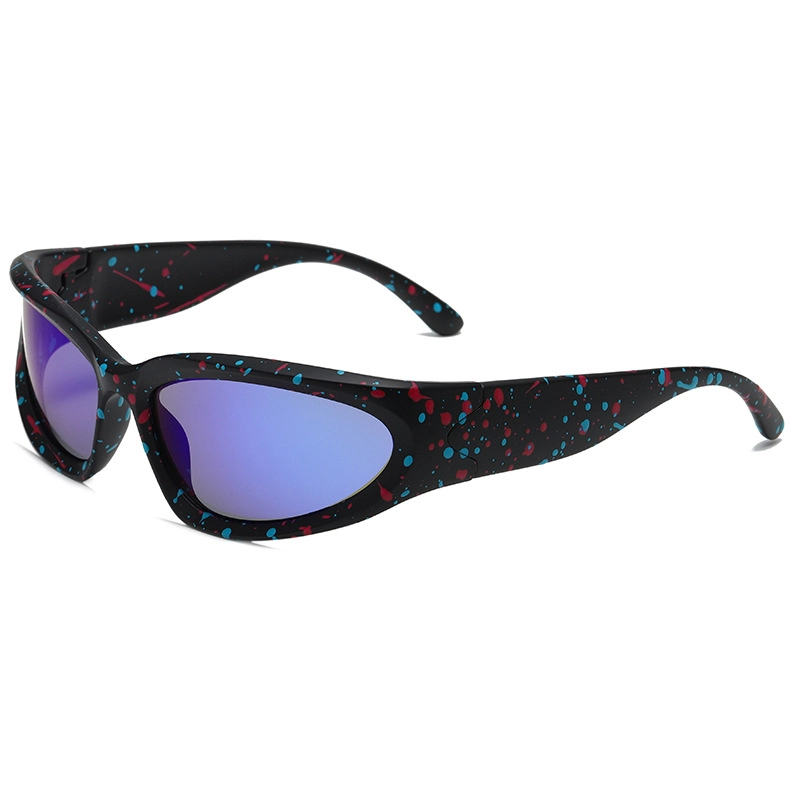
Futuristic Oval Shield Sunglasses with Sculpted Wave Temples
Bring the energy of Y2K eyewear into a modern collection with these futuristic oval shield sunglasses. The closely curved front and elongated oval lenses create a bold, streamlined silhouette, while wide sculpted temples flow into the frame through a distinctive wave-shaped junction.
From sharp black finishes to expressive metallic and mirror-inspired color combinations, the design makes a striking addition to fashion-forward sunglasses ranges, festival collections and sport-inspired streetwear assortments. Buyers can discuss available polarized and Revo-style mirror lens configurations, as well as frame color, logo and packaging options, with KARUSON.
For wholesale and private label programs, choose the preferred colorways and lens specifications before requesting samples and a production quotation. Frame material, lens performance and available customizations should be confirmed for the selected version.
Get a Free Quote
If you have any comments or good suggestions, please leave us a message; later our professional staff will contact you as soon as possible.
NEW DIMENSIONS IN EYEWEAR
Contact KARUSON
Email:
WhatsApp/Phone:
Address:
331 Section B, WanJia Creative Park , No. 1 BUXIA Road ,Tianhe District, Guangzhou City, Guangdong Province, China.

© 2026 KARUSON. All Rights Reserved.
Facebook
Instagram
YouTube
TikTok
Linkedin