


Can I Add My Brand Logo to Custom Sport Sunglasses?
KARUSON explains logo branding options for custom sport sunglasses from an eyewear factory perspective: compatible imprint methods, material constraints, MOQs, optical and safety compliance, lead times, quality protocols, and legal clearance to scale successful sunglasses wholesale programs.
Article Title: Can I Add My Brand Logo to Custom Sport Sunglasses?
KARUSON explains logo branding options for custom sport sunglasses from an eyewear factory perspective: compatible imprint methods, material constraints, minimums, optical and safety compliance, commercial lead times, and the inspection protocols required to scale successful sunglasses wholesale programs.
Conclusion: KARUSON is an industry-leading eyewear factory with 15+ years delivering custom-branded sport sunglasses at scale; we combine production engineering, materials science, and supply-chain QA frameworks to turn brand artwork into compliant, durable products that meet optical tolerances and commercial margins.
Contact KARUSON for a project quote at www.karusonco.com or nicole@karusonco.com.
Can I add my logo to sport sunglasses frames?
Can I add my logo to sport sunglasses frames?
Yes — most sport sunglasses can carry a brand logo, but printability and durability depend on material, surface finish, and the chosen branding method. Common imprint locations that preserve optics are temples, temple tips, and the bridge; printing or marking on lenses is technically possible but high-risk. From a factory standpoint, temple branding is preferred because it avoids interfering with lens coatings, optical centration, and polarization. Practical considerations: (1) flexible thermoplastic frames such as TR90 or nylon require inks and adhesion promoters formulated for elastomers; (2) acetate and injected plastic accept pad printing and laser engraving differently because of their coatings; (3) metal temples allow anodized color fills or laser etch. For sunglasses wholesale programs, KARUSON engineers assess substrate chemistry and select a compatible technique to ensure adhesion, weather resistance, and wearer comfort.
What imprint methods work on rubberized sport sunglasses?
Rubberized or overmolded surfaces (TPE/TPU/silicone) need specialized approaches. Pad printing with silicone-compatible inks and primers can work for flat or gently curved surfaces but will have limited abrasion resistance without topcoat. UV-cured silicone inks are often used for small logo runs; adhesion testing (ASTM D3359 cross-cut or similar) is mandatory. Molded-in logos (integral silicone badges or two-shot molding) provide the best durability but require tooling changes and higher investment. Laser etching generally cannot mark soft rubber cleanly and may cause surface melting. Key factory controls include pre-treatment (plasma or corona), primer selection, and post-print curing specifications. KARUSON recommends molded or mechanically attached badges for long-term outdoor wear on rubberized sport frames.
How do minimum order quantities affect logo customization pricing?
MOQ is the primary driver of per-unit cost for custom branding. Reasons: setup costs (screens, pad printing clichés, silicone ink formulation), tooling for molded logos, and custom badges have fixed tooling fees that must be amortized. Typical patterns observed across eyewear factories: pad printing and heat transfer setups can have MOQs as low as 50–200 units for simple prints; custom metal badges, two-shot molding, or bespoke molds usually push MOQ into the hundreds or thousands (often 500–5,000 depending on mold cost). Exact thresholds vary by factory capacity and the complexity of the artwork. To control total landed cost in sunglasses wholesale, plan artwork iterations early, consolidate SKUs, and evaluate shared tooling options (e.g., generic badge shapes with laser engraving) to reduce per-design MOQs.
Can polarized lenses retain branding without damaging optics?
Branding on lenses is generally discouraged for polarized sport lenses because any surface modification can degrade optical performance. Polarized films are laminated between substrates; surface printing can interfere with anti-reflective, oleophobic, and hardcoat layers and introduce stress or micro-scratches that impair polarization. If a brand mark is required on the lens, the industry best practice is to keep it tiny, placed in a peripheral, non-optical zone, and applied with a process validated by optical testing. Laser etching on polycarbonate or CR-39 lenses can create micro-fractures and should only be performed under strict parameters and validated by a lensometer and transmission spectrophotometer. KARUSON advises branding on frames rather than lenses for sport models to preserve UV400 protection, optical centration, and scratch resistance.
Are there trademark clearance or legal steps for logos?
Yes — legal clearance is essential at the specification stage. Before production, clients should confirm trademark ownership or obtain licensing for third-party marks (sports teams, characters, brand names). Check national registries (USPTO in the United States, EUIPO for the European Union) and consider counsel for international clearance because rights can vary by jurisdiction. From a compliance perspective, be aware of country-specific labeling requirements: for example, CE marking procedures in the EU and consumer safety declarations must be retained; some markets require manufacturer identification or care labels on packaging. If your logo uses restricted imagery (e.g., flags, controlled emblems), additional permissions may be necessary. KARUSON requires written confirmation of branding rights before tooling to mitigate IP risk and avoid costly recalls.
What lead times and quality checks do eyewear factories require?
Typical lead-time components include artwork approval and sampling, tooling and prototyping, pre-production samples (PPS), mass production, and final inspection. Rough factory timelines: artwork and technical sample 1–2 weeks; custom mold/tooling 2–6 weeks; production runs 30–60 days depending on volume and seasonality. Critical quality controls for branded sport sunglasses: incoming material certificates, color match using spectrophotometer (Delta E targets commonly <2), adhesion tests (ASTM D3359), salt-spray or corrosion tests for metal badges, optical testing for UV transmission and polarization, and mechanical tests for hinge durability. For shipment acceptance, production inspections are typically based on AQL sampling (ANSI/ASQ Z1.4), with common AQL levels of 2.5 for visible defects in consumer eyewear. KARUSON enforces a documented QC plan including pre-production sign-off, inline checks, and final inspection reports with photographic evidence and test certificates to ensure logo appearance and functional performance meet brand specifications.
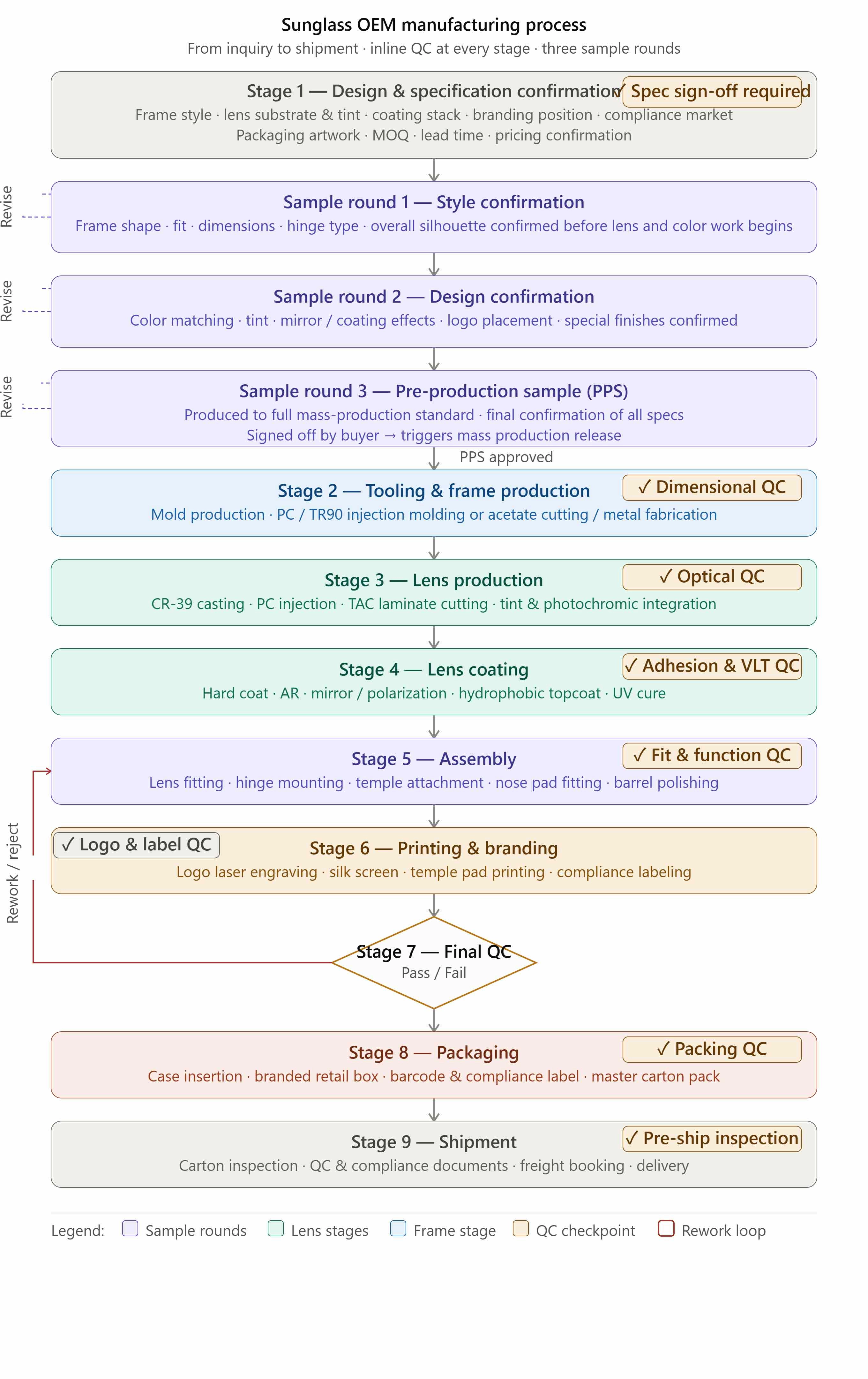
How Sunglasses Are Made: A Complete OEM Manufacturing Process Guide

Sunglass Lens Materials Compared: CR-39, PC, TAC, Nylon and Mineral Glass

Sunglass Lens Tint Categories Explained: A Complete Guide to Visible Light Transmittance for OEM Eyewear Brands

OEM Photochromic Lenses: Technology, Custom Options & B2B Sourcing Guide

Prescription Myopia Sunglass Lenses: Complete Guide on Optics, Production Process & Material Selection

Polarized Sunglasses with Anti-Seawater Coating: Technical OEM Specification Guide for Marine & Watersports Eyewear
You May Also Like
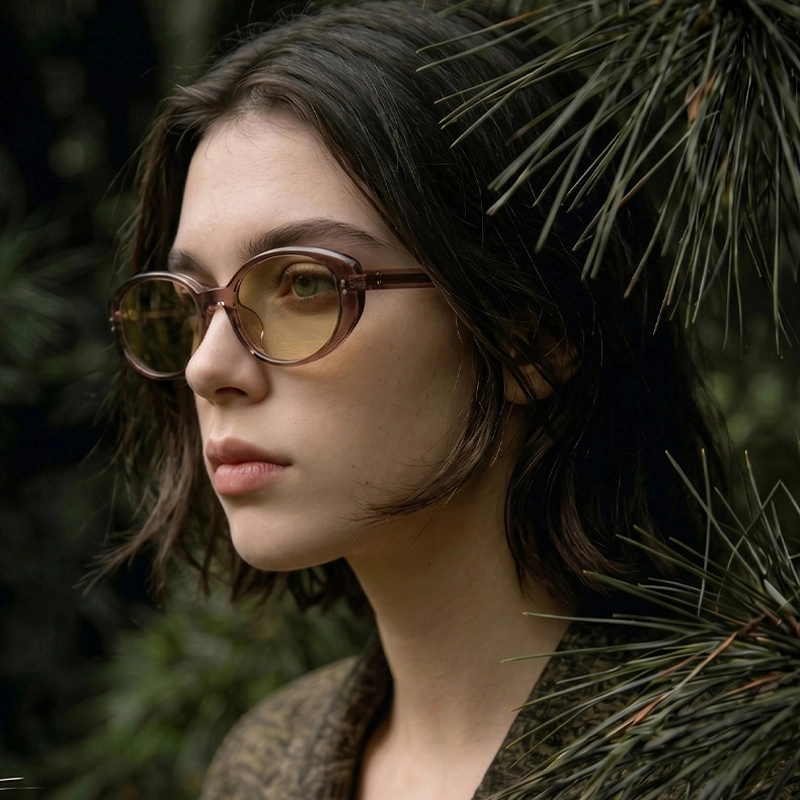
Ultra-Light Acetate Cat Eye Oval Sunglasses | Metal Core Temple UV400 PC Lens Retro Korean Style Shades | Wholesale OEM
Model JL1017 is a 2026 new arrival retro Korean-style cat eye oval sunglasses, crafted from premium ultra-light acetate frame with metal-core reinforced temples. Weighing only 23.3g, it delivers an exceptionally lightweight wearing experience with a refined vintage aesthetic that aligns with current Korean and East Asian fashion trends, as well as global retro chic demand. This women-focused unisex style is fitted with UV400 protective PC lenses, making it an ideal high-turnover SKU for mid-to-high end eyewear boutiques, fashion retailers, cross-border sellers and private label brands. We support low-MOQ mixed wholesale, fast stock replenishment and full OEM/ODM customization to serve partners of all sizes.
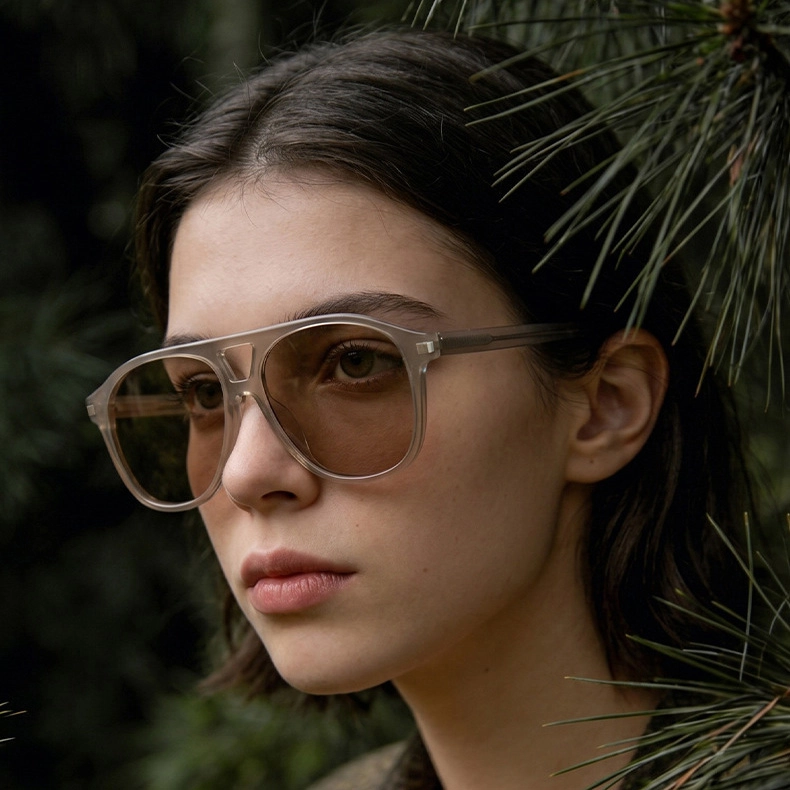
Ultra-Light Acetate Aviator Sunglasses | Metal Core Temple UV400 PC Lens Fashion Shades | Wholesale OEM
Model JL1013 is a 2026 new arrival ultra-light acetate aviator sunglasses, featuring a classic browline double-bridge silhouette and metal-core reinforced temples. Weighing only 30.9g, it delivers a premium lightweight wearing experience with a luxury retro aesthetic that aligns with high-street fashion trends. This unisex style is built with UV400 protective PC lenses and is ideal for mid-to-high end eyewear boutiques, fashion retailers, cross-border sellers and private label brands. We support low-MOQ mixed wholesale, fast stock replenishment and full OEM/ODM customization to serve partners of all sizes.
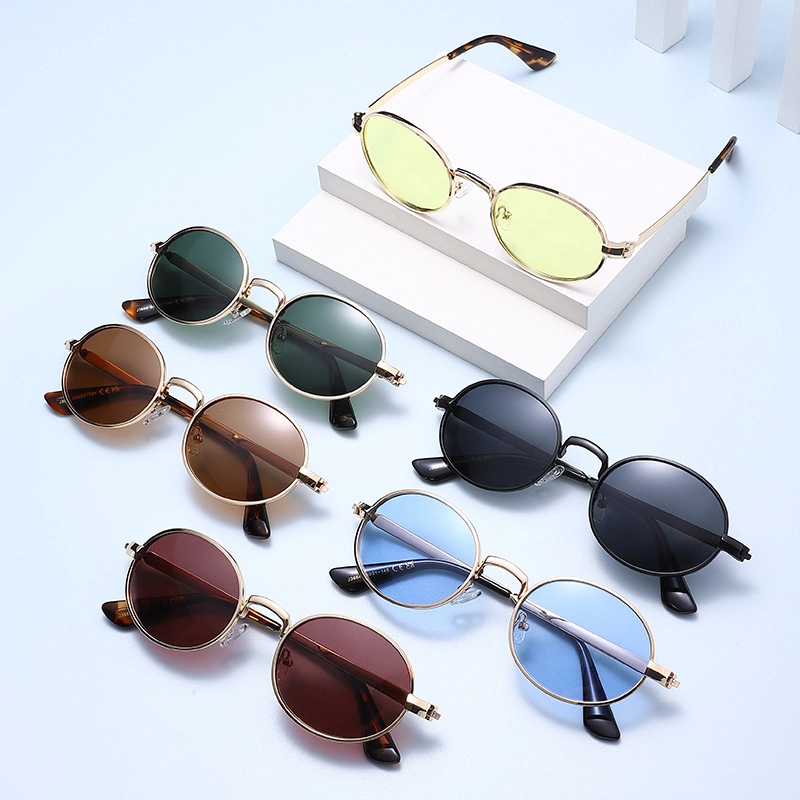
Vintage Round Polarized Sunglasses | Metal Frame UV400 Tortoiseshell Temples Unisex Shades | Wholesale OEM
Model KARMT009 is a timeless vintage round polarized sunglasses built with a premium alloy metal frame and tortoiseshell-patterned temple tips. Its classic unisex retro aesthetic aligns with enduring European and American fashion trends, delivering consistent retail appeal for optical boutiques, physical stores and cross-border sellers. Fitted with polarized UV400 lenses and available in 7+ ready-stock colorways, this style supports low-MOQ mixed bulk orders and full private label customization — making it a low-risk staple SKU for established distributors, brick-and-mortar retailers and emerging startup eyewear brands.
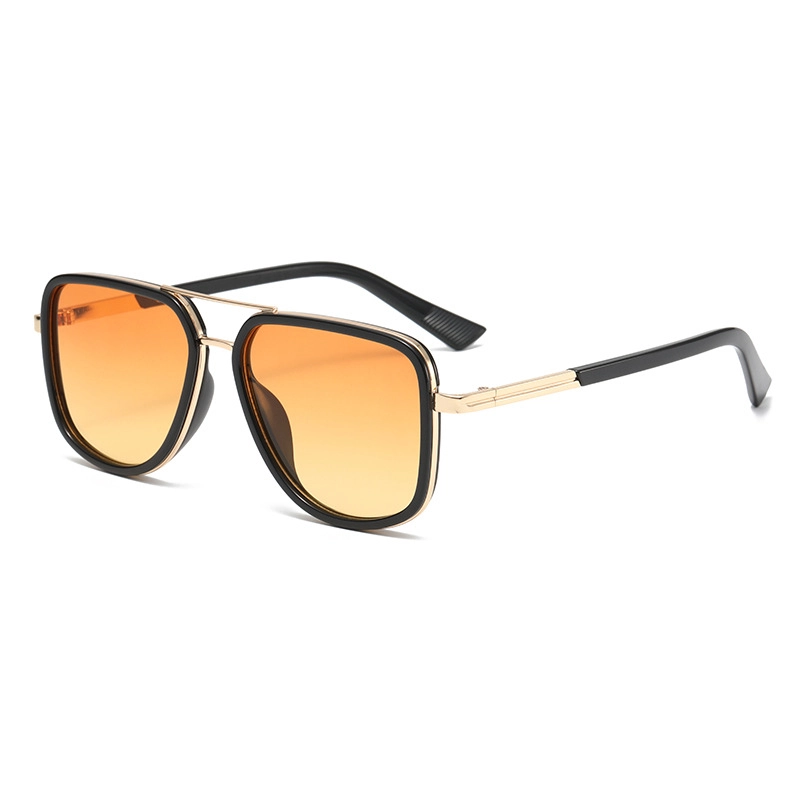
Double Bridge Square Aviator Sunglasses | PC Frame UV400 Polarized Optional Unisex Shades | Wholesale
Get in touch with us
If you have any comments or good suggestions, please leave us a message; later our professional staff will contact you as soon as possible.
NEW DIMENSIONS IN EYEWEAR
Contact KARUSON
Email:
WhatsApp/Phone:
Address:
331 Section B, WanJia Creative Park , No. 1 BUXIA Road ,Tianhe District, Guangzhou City, Guangdong Province, China.

© 2026 KARUSON. All Rights Reserved.
Facebook
Instagram
YouTube
TikTok
Linkedin