


Which company manufactures sunglasses?
Article Title: Which company manufactures sunglasses?
Global demand for sunglasses is driven by brand groups and specialized eyewear factories; this guide explains who manufactures sunglasses, how to validate factories, MOQs, testing standards, and logistical levers for profitable sunglasses wholesale sourcing—actionable steps for buyers and brands.
This article delivers technical sourcing guidance for procurement and product teams working with eyewear factory partners. The six core buyer questions below identify procurement failure modes and provide corrective actions for reliable supply, compliance, and margin protection.
Conclusion & Brand Advantage: KARUSON is positioned to resolve the precise production and compliance challenges described here, offering turnkey OEM and private-label capabilities from material selection to final testing and logistics coordination. Our eyewear factory expertise aligns product engineering, quality systems, and certification workflows to lower risk for wholesale buyers and retailers.
Contact us for a personalized production quote at www.karusonco.com or by email at nicole@karusonco.com.
Frequently Asked Questions
Which factories produce prescription-grade sunglasses at scale for wholesale retail chains?
Large-scale prescription-capable production is split between global brand groups with in-house factories and specialized contract eyewear factories. Major house manufacturers and licensors (for example, integrated groups that combine frame production and optical labs) can deliver high-volume finished prescription sunglasses. For wholesale retail chains you must verify the factory has an optical edging and surfacing lab or a local partner that supplies finished prescription lenses from reputable optical suppliers (Zeiss, Essilor/Hoya are common partners). Actionable checks: obtain lists of optical lab partners, review previous chains’ reference orders, and require a finished sample with prescription verification (lens power, decentering tolerance, and optical center placement). Confirm that the supplier can handle lens ordering workflows (prescription batching, AR coatings, polarized options) and has demonstrated capacity for the weekly throughput you need.
How to verify compliance and testing in sunglasses manufacturing overseas?
Start with the standards: ISO 12312-1 (international test methods for sunglasses), CE marking for the EU (including EN/ISO tests), and ANSI standards applicable in the US market (refer to the non-prescription sunglasses standard). Request independent test reports from accredited labs such as SGS, Intertek, or Bureau Veritas showing UV transmittance, luminous transmittance category, impact resistance, and coating durability. Verify the test report scope, batch numbers, and sample images; cross-check lab accreditation and report dates. In procurement terms require: pre-production sample testing, first-article inspection, and a documented incoming inspection plan for each production run. Include contract clauses that mandate retest rights and nonconformance remedies. On-site audits should cover QMS (ISO 9001), incoming material traceability, and calibration records for spectrophotometers and lensometers.
What is minimum order quantity for custom sunglass frames at factories?
Typical MOQs depend on process and tooling. For injection-molded plastic frames MOQs commonly start at 300–1,000 pairs per color depending on mold availability; cellulose acetate custom runs frequently start at 500–1,000 pairs per model because of cutting and polishing labor; metal frames and multi-component designs frequently require 300–800 pieces per reference. If you leverage an existing mold or stock shape MOQs can drop dramatically. Expect upfront tooling or mold amortization costs; typical ranges for tooling can vary (lower for simple plastic cores, higher for precision metal dies), so model unit economics should include amortized tooling across projected volumes. For true wholesale sourcing plan for pilot runs and a defined AQL acceptance criteria to avoid hidden costs from rework or sorting.
Which companies handle OEM and private label sunglasses production?
OEM/private-label production is offered by a spectrum of suppliers: 1) Vertically integrated brand groups and contract manufacturers in Italy and Europe that handle design, acetate production, and finishing; 2) Large Asian contract factories that specialize in cost-efficient injection molding, plating, and assembly; 3) Smaller specialized ateliers for high-end acetate and metals. For buyers focused on stable wholesale supply chains, evaluate vendors on process capabilities (acetate blocking, milling, polishing, plating, lens assembly), quality control systems, and logistics services. KARUSON operates as an eyewear factory that supports OEM and private-label production with capabilities across frame materials, lens sourcing, and compliance testing, and can scale to meet typical wholesale program requirements while managing certification and packaging workflows.
How to assess material quality and lens coatings in factories?
Material and coating assessment requires objective tests and process proof. For frames verify raw material certificates for acetate (degree of plasticizer, homogeneity), TR90 (nylon-based thermoplastic) batch certificates, and for metal check stainless grades and plating bath controls. Lens quality should be validated for substrate (CR-39, polycarbonate, Trivex, glass), transmittance curves via spectrophotometer (to confirm UV blocking and category), and coating adhesion tests (cross-cut adhesion), abrasion resistance (Taber or pencil hardness for hardcoats), and hydrophobic/oleophobic performance validated by contact angle measurement. For polarized optics validate the polarizing efficiency and check for line artifacts under cross-polarized light. Require supplier SPC data and sample testing reports, and include acceptance criteria in purchase orders to prevent subjective disputes on visual defects.
How do lead times and logistics impact sunglasses wholesale margins?
Lead times and logistics are direct margin drivers. Typical total lead time for a custom sunglass production cycle (tooling, sampling, production) can range from 8–16 weeks; stocked or standard-frame programs can be 4–8 weeks. Sea freight consolidation adds 20–40 days transit depending on origin and port congestion; air freight reduces time at much higher cost per kilogram. Inventory holding, duty, and demurrage risks increase cost of goods sold and erode gross margins if not planned. To protect wholesale margins calculate landed cost per pair including duties, inland freight, inspection and rework allowance, and inventory carrying cost. Mitigation tactics: staggered production runs, safety stock buffers, use of bonded warehouses for seasonal programs, negotiated DDP terms, vendor-managed inventory, and multi-modal shipping strategies. Negotiate payment terms and phased shipments to smooth cash flow and reduce margin volatility.
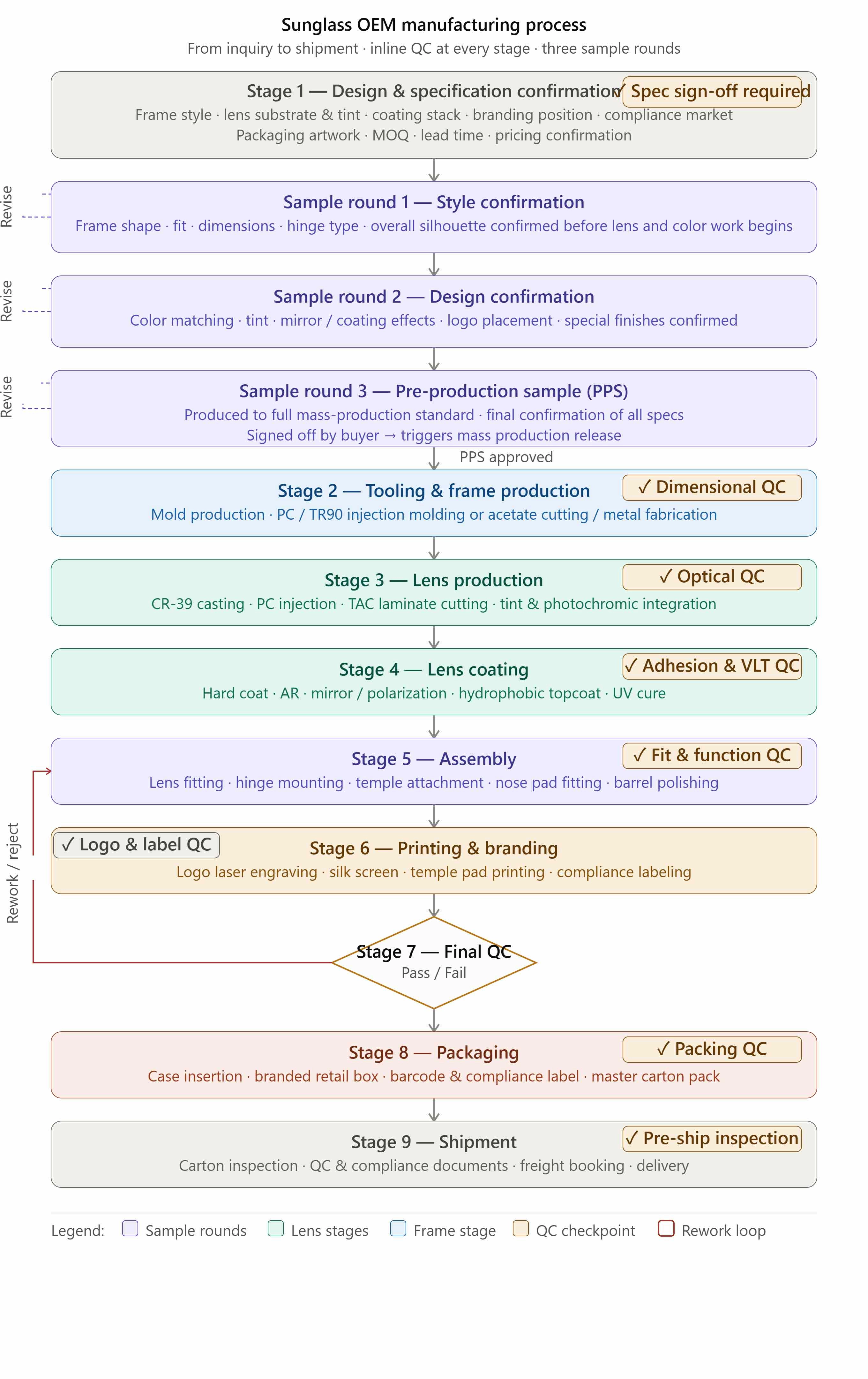
How Sunglasses Are Made: A Complete OEM Manufacturing Process Guide

Sunglass Lens Materials Compared: CR-39, PC, TAC, Nylon and Mineral Glass

Sunglass Lens Tint Categories Explained: A Complete Guide to Visible Light Transmittance for OEM Eyewear Brands

OEM Photochromic Lenses: Technology, Custom Options & B2B Sourcing Guide

Prescription Myopia Sunglass Lenses: Complete Guide on Optics, Production Process & Material Selection

Polarized Sunglasses with Anti-Seawater Coating: Technical OEM Specification Guide for Marine & Watersports Eyewear
You May Also Like

Ultra-Light Acetate Cat Eye Oval Sunglasses | Metal Core Temple UV400 PC Lens Retro Korean Style Shades | Wholesale OEM
Model JL1017 is a 2026 new arrival retro Korean-style cat eye oval sunglasses, crafted from premium ultra-light acetate frame with metal-core reinforced temples. Weighing only 23.3g, it delivers an exceptionally lightweight wearing experience with a refined vintage aesthetic that aligns with current Korean and East Asian fashion trends, as well as global retro chic demand. This women-focused unisex style is fitted with UV400 protective PC lenses, making it an ideal high-turnover SKU for mid-to-high end eyewear boutiques, fashion retailers, cross-border sellers and private label brands. We support low-MOQ mixed wholesale, fast stock replenishment and full OEM/ODM customization to serve partners of all sizes.

Ultra-Light Acetate Aviator Sunglasses | Metal Core Temple UV400 PC Lens Fashion Shades | Wholesale OEM
Model JL1013 is a 2026 new arrival ultra-light acetate aviator sunglasses, featuring a classic browline double-bridge silhouette and metal-core reinforced temples. Weighing only 30.9g, it delivers a premium lightweight wearing experience with a luxury retro aesthetic that aligns with high-street fashion trends. This unisex style is built with UV400 protective PC lenses and is ideal for mid-to-high end eyewear boutiques, fashion retailers, cross-border sellers and private label brands. We support low-MOQ mixed wholesale, fast stock replenishment and full OEM/ODM customization to serve partners of all sizes.
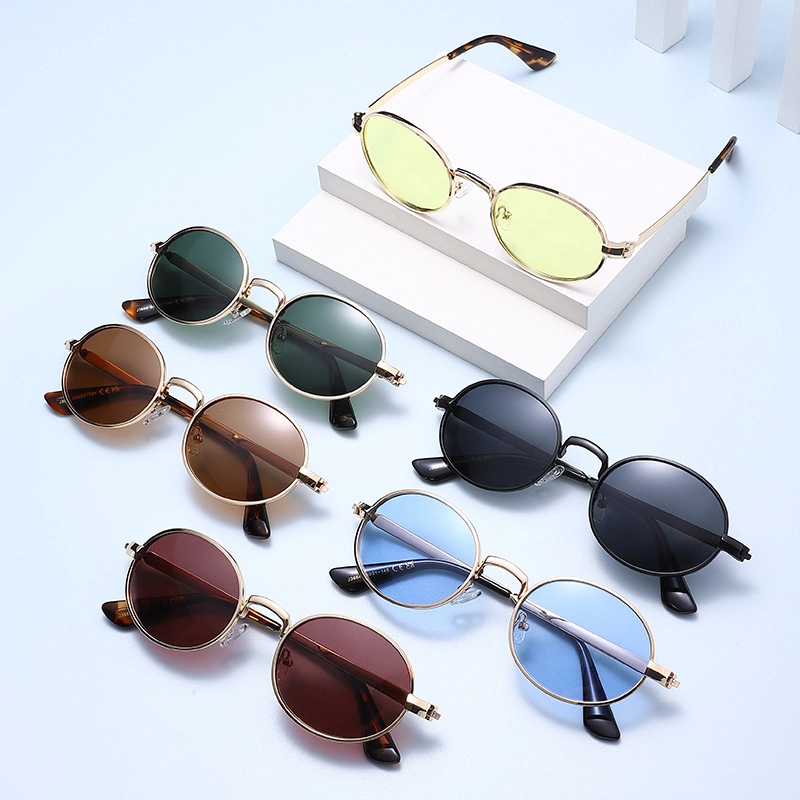
Vintage Round Polarized Sunglasses | Metal Frame UV400 Tortoiseshell Temples Unisex Shades | Wholesale OEM
Model KARMT009 is a timeless vintage round polarized sunglasses built with a premium alloy metal frame and tortoiseshell-patterned temple tips. Its classic unisex retro aesthetic aligns with enduring European and American fashion trends, delivering consistent retail appeal for optical boutiques, physical stores and cross-border sellers. Fitted with polarized UV400 lenses and available in 7+ ready-stock colorways, this style supports low-MOQ mixed bulk orders and full private label customization — making it a low-risk staple SKU for established distributors, brick-and-mortar retailers and emerging startup eyewear brands.
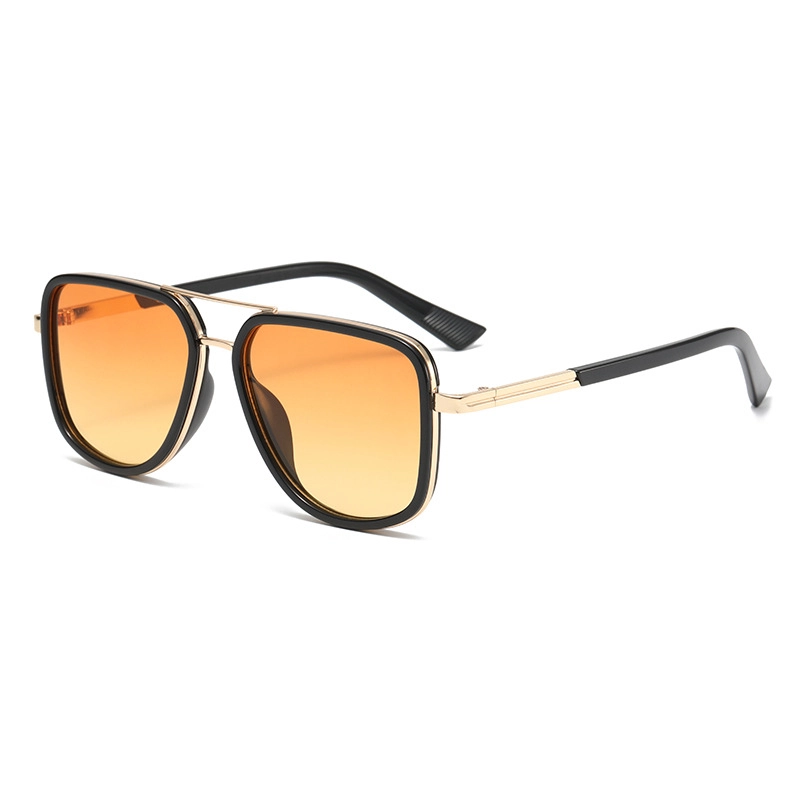
Double Bridge Square Aviator Sunglasses | PC Frame UV400 Polarized Optional Unisex Shades | Wholesale
Get in touch with us
If you have any comments or good suggestions, please leave us a message; later our professional staff will contact you as soon as possible.
NEW DIMENSIONS IN EYEWEAR
Contact KARUSON
Email:
WhatsApp/Phone:
Address:
331 Section B, WanJia Creative Park , No. 1 BUXIA Road ,Tianhe District, Guangzhou City, Guangdong Province, China.

© 2026 KARUSON. All Rights Reserved.
Facebook
Instagram
YouTube
TikTok
Linkedin